
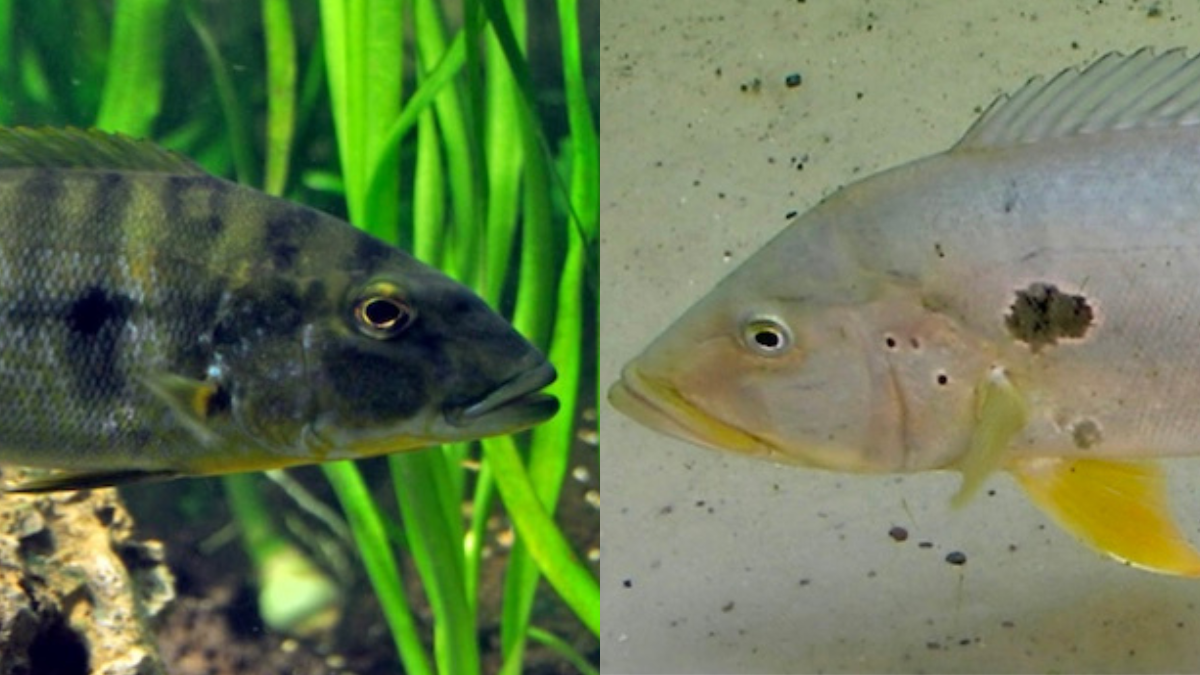
Has the Emperor Cichlid Lost its Crown as World’s Largest Cichlid?
The Emperor cichlid, Boulengerochromis microlepis, has long been hailed as the largest cichlid species in the world, but now I’m beginning to question that.
Microlepis is huge, rumoured to grow up to three feet in length in its native Lake Tanganyika, and having worked with one, I can attest that they are next-level big, when compared to say a foot long Oscar. And I do think they may grow up to 90cm, and certainly over 75cm. They are a huge fish, pair-forming when adult, and territorial, making them a poor choice for any tank outside of public aquaria.
Emperor cichlids don’t even look like cichlids, with that more elongate shape, long tail and crescent shaped caudal fin. They look like a marine predator.

But cichlids they certainly are, in the subfamily Pseudocrenilabrinae, which includes pretty much every lacustrine and riverine African cichlid from East African lakes to Madagascar, West African rivers, North, and South Africa. Some 1100 species (probably a lot more,) are contained within it, although Boulengerochromis remains the only member of its genus.
Boulengerochromis are much filmed in the clear fresh waters of Lake Tanganyika where they take on all comers in defence of their brood. Even turtles!
Fishbase.org lists a maximum total length for Boulengerochromis microlepis as 80cm/31.5” TL, and a weight of 4.5kg, or 9.92 lb. But how does that stack up against our cichlid friends from South America?
From northern South America comes the Turquoise cichlid, or Umbie to its fans, measuring 47.5cm or 18.7”, according to Fishbase. No weight is mentioned. A male Jaguar cichlid can top the tape measure at 55cm/21.7” however, making it longer, but with a disproportionate published weight of just 1.6kg, or 3.5 lb.

Long known as a top three contender for world’s largest cichlid is the Jaguar cichlid’s cousin, Parachromis dovii, the Wolf Cichlid. Hailing from Honduras and Costa Rica, male Dovii get huge, at 72cm/28.3”, and weighing 6.8kg/15 lb. That’s heavier than Boulengerochromis at 4.5kg, and only a couple of inches shorter. Large Wolf cichlids are the epitome of Beast Mode, and about as proper a cichlid as you can get. With sharp fangs to boot.

But travel South to the Amazon basin and you enter the realm of Peacock Bass, Cichla spp. Cichlidae’s version of the Northern Pike.
Cichla are also elongate and bass-like, like Boulengerochromis, their slung back dorsal, anal and caudal fins providing thrust when lunging at fishy prey, and making them popular with sport fishermen.
There are 16 valid species of Cichla currently, all of them similar, and all of them huge. Most species can vie for top two largest cichlids, with published sizes around 75cm/30”, and 6.8kg/15lb.
But Cichla temensis, from the Rio Negro and Uatumã River drainages, Orinoco River basin and tributaries of the Orinoco River in Venezuela and Colombia, tops them all.

Fishbase lists a maximum length of 99cm/39” for Cichla temensis, and a maximum weight of 12.2kg, or 26.9lb.
This, fishy friends, makes Cichla temensis the largest cichlid species on the planet. And Fishbase has references for all the above dimensions too.
The Emperor has lost his crown.
Other contenders
There are some other large cichlids from Africa in the Tilapia and Oreochromis genera. The Nile Tilapia world fishing record stands at 9lb, or 4kg, with unofficial lengths of 60cm/24”. But a cichlid you never see in the aquarium trade is the Haplochromine Serranochromis robustus. Native to rivers flowing in and out of Lake Malawi, the Yellow Belly Bream is a popular sport and food fish, measuring up to 56cm/22”, and weighing up to 6.1kg/13.4 lb, heavier than the Emperor cichlid from Lake Tanganyika.

Tilapia records will likely continue to expand as they are cultured and hybridised for aquaculture. Hybridising can bring “hybrid vigour,” super fish, capable of growing larger than both parent species.
Tilapia have also been introduced around the tropical freshwater world as food fish, invading new waters and out-eating every endemic species they come across.
So watch this space…
Image credits: Dan Koehl, CC BY 3.0 https://creativecommons.org/licenses/by/3.0, via Wikimedia Commons
Dovii Sesamehoneytart, CC BY-SA 3.0 https://creativecommons.org/licenses/by-sa/3.0, via Wikimedia Commons
Jag George Chernilevsky, Public domain, via Wikimedia Commons
Temensis NasserHalaweh, CC BY-SA 4.0 https://creativecommons.org/licenses/by-sa/4.0, via Wikimedia Commons
Serrano Frederick Hermanus Van der Bank, University of Johannesburg, Copyrighted free use, via Wikimedia Commons
Umbie Tylwyth Eldar, CC BY-SA 4.0 https://creativecommons.org/licenses/by-sa/4.0, via Wikimedia Commons
Cichla By Tiia Monto – Own work, CC BY-SA 3.0, https://commons.wikimedia.org/w/index.php?curid=12613251


